
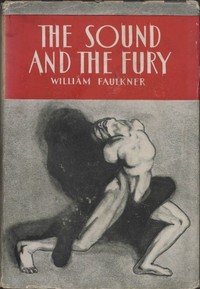
William Faulkner wrote The Sound and the Fury in 1929. He later said it was the novel he loved the most because it was the one he had failed the most ambitiously at — he rewrote it four times, each time from a different narrator's perspective, never satisfied that he had rendered what he saw.
He was wrong. It is one of the dozen greatest novels written in English.
Open The Sound and the Fury in warpread →
What The Sound and the Fury Is About
The Compsons are an old Mississippi family in the process of collapse. The father drinks. The mother performs invalid illness. The land is being sold. The daughter Caddy — the most important figure in the novel — never gets her own section: she exists entirely through the eyes of her brothers, who are all in love with her in different ways.
The Benjy section (April 7, 1928): Benjy is thirty-three, intellectually disabled, experiencing time as an undifferentiated pool of sensation. He smells Caddy everywhere. His narration slides between 1928 and 1900–1910 without warning. This section must be felt before it can be understood.
The Quentin section (June 2, 1910): Quentin is at Harvard, eighteen years before Benjy's section. Today he will kill himself. His narration is stream-of-consciousness, obsessed with time, with honour, with Caddy's lost purity and his own failure to protect it. The watch his father gave him is the novel's central image.
The Jason section (April 6, 1928): Jason is bitter, practical, cruel. He has been stealing money from Caddy's daughter (also named Quentin) for years. His narration is the most readable — clear, caustic, self-pitying, and damning.
The Dilsey section (April 8, 1928): Told in third person. Dilsey, the family's Black servant, goes to church on Easter Sunday. She weeps throughout the sermon, having seen the beginning and the end.
How Long Is The Sound and the Fury?
| Reading speed | Time to finish |
|---|---|
| 200 WPM | ~7.1 hours |
| 250 WPM (average) | ~5.7 hours |
| 350 WPM (practised) | ~4.1 hours |
| 500 WPM (RSVP) | ~2.8 hours |
How to Read It
Do not give up in the Benjy section. The disorientation is the point. Time-shifts are always triggered by sensory association — the word "caddie" on a golf course sends Benjy back to childhood. Track the triggers, not the chronology.
warpread's RSVP mode by section:
- Benjy section: 250–280 WPM. No faster.
- Quentin section: 300 WPM. The stream-of-consciousness flows.
- Jason section: 400 WPM. Conventional prose, furious energy.
- Dilsey section: 300 WPM. Let Faulkner's cadences reach you.
The Appendix — Faulkner wrote an appendix in 1945, often appended to modern editions. Read it after the novel, not before. It provides genealogy and summary; reading it first destroys the experience.
Quentin's watch: The clock imagery is everywhere. Quentin breaks his watch on the day he dies. His father told him that time is mankind's misfortune only if you surrender to it. Track this thread.
For the full speed reading technique, see how to read faster.
Where to Read The Sound and the Fury Free
- warpread library — instant reading, RSVP mode, no account needed
- Project Gutenberg — complete text, EPUB and download
- Standard Ebooks — best-formatted free EPUB
Related Reading
- As I Lay Dying — Faulkner's next Yoknapatawpha novel; multiple narrators, more accessible
- Mrs Dalloway — Woolf's stream-of-consciousness, same year, less disorienting
- Notes from Underground — Dostoevsky's ur-text for unreliable, self-lacerating narration
For the full list of free classics, see the 50 best free classic novels to read online.
Topics
Frequently asked questions
Is The Sound and the Fury free to read online?
Yes. The Sound and the Fury was published in 1929 and is in the public domain in some jurisdictions, though US copyright status is complex for 1920s works. However, warpread.app's library includes it via Project Gutenberg (ID 75170), where it is freely available. No account, no download, no payment.
How long does it take to read The Sound and the Fury?
The Sound and the Fury is approximately 85,000 words. At 250 WPM it takes about 5.7 hours. At 350 WPM around 4.1 hours. At 500 WPM with RSVP reading, about 2.8 hours. However, Faulkner's density means most readers go slower than their usual pace, especially through the Benjy section.
What is The Sound and the Fury about?
The Sound and the Fury tells the story of the Compson family's decline in Jefferson, Mississippi, across four days spanning 1910 to 1928. The family's corruption is seen through four narrators: Benjy, an intellectually disabled man who experiences time non-linearly; Quentin, the eldest son who is obsessed with honour and his sister Caddy; Jason, the bitter, financially scheming third son; and Dilsey, the Black servant who holds what remains of the family together.
Why is The Sound and the Fury so difficult to read?
The Benjy section (April 7, 1928) is the most challenging opening in American fiction — Benjy cannot distinguish between past and present, so the narration jumps between time periods without transition. Faulkner used italics in manuscript to signal these shifts, but not all editions preserve them. The key: every shift is triggered by a sensory association (a smell, a sound, a word). Once you recognise this mechanism, the section becomes not just manageable but extraordinary.
What is the correct reading order for The Sound and the Fury?
Read in the published order: Benjy section first, Quentin second, Jason third, Dilsey fourth. Some guides recommend reading the Dilsey section first for orientation. This is a mistake — the disorientation of the Benjy section is intentional and is the point. Faulkner wanted readers to experience Benjy's consciousness before giving them the rational narrators who explain what they have been seeing.
Is The Sound and the Fury good for RSVP reading?
The Sound and the Fury is one of the few novels where RSVP reading requires genuine strategy. The Benjy section needs slow reading (250–280 WPM) to track the time-shifts. The Jason section — the most conventionally written — is excellent at 400 WPM. The Dilsey section, which is the emotional culmination, should be read at your most attentive pace: 300 WPM minimum, warpread's RSVP mode with focus fully on.
Ready to apply these techniques?
Take the free reading speed test to benchmark your WPM and get personalised technique suggestions.